
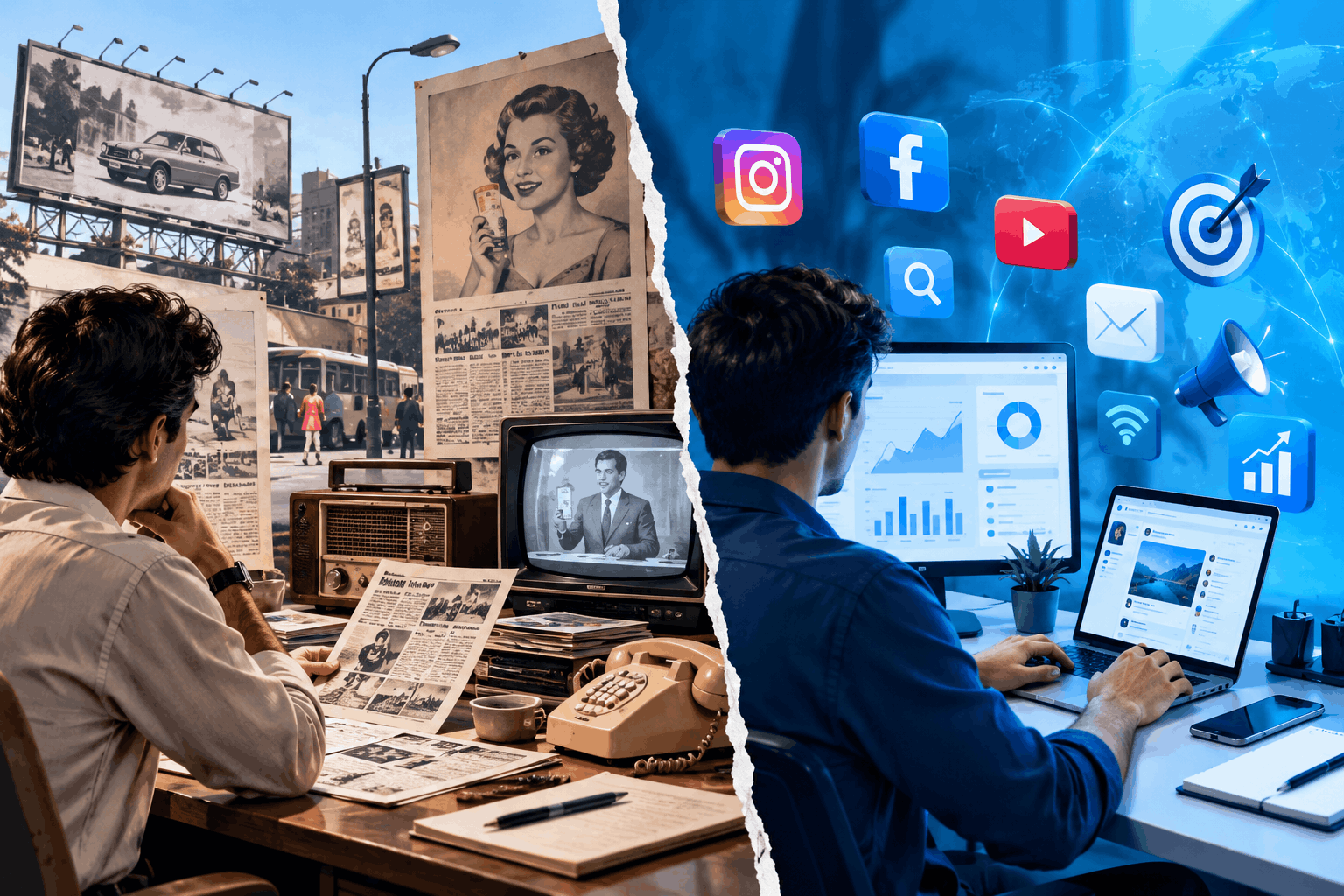
How Businesses Reached Customers Before Digital Marketing
Imagine running a business in 1985.
There was no Facebook to promote your business. No Instagram Reels to show your products. No Google Ads to bring customers to your website. There was no WhatsApp for quick customer conversations and no email campaign that could reach thousands of people in a few clicks.
Yet, businesses were still finding customers, building brands, and making sales.
Business marketing in 1985 was very different from what we know today. It was mostly based on newspapers, television, radio, posters, printed materials, telephone calls, salespeople, and personal relationships.
Marketing was slower, but it was also very personal. Businesses had to think carefully about where they spent their money because measuring results was much harder than it is today.
This blog looks at how businesses marketed themselves in 1985 and how those methods compare with the digital marketing world we use today.
What Was Business Marketing Like in 1985?
Marketing in 1985 depended mainly on traditional media and direct communication. Businesses needed to take their message to places where people were already spending their time.
The main marketing channels included:
- Newspapers
- Radio
- Television
- Posters and billboards
- Flyers and pamphlets
- Direct mail
- Telephone calls
- Door-to-door sales
- Trade shows and local events
- Word-of-mouth recommendations
A business could not simply create an online ad and wait for customers to click it. Reaching people required planning, printing, phone calls, physical meetings, and often a lot of patience.
For local businesses, location was especially important. A restaurant, clothing shop, repair service, or local retailer often focused its marketing on people living or working nearby.
Newspaper Advertising Was a Major Marketing Tool
Newspapers played an important role in business marketing in 1985.
Businesses could place advertisements in local newspapers to promote their products, services, special offers, new stores, or upcoming events.
For example, a clothing store might publish an advertisement announcing a seasonal sale. A restaurant could promote its new menu. A real estate company could advertise properties for sale.
Newspaper advertising had several benefits:
- It could reach a large local audience.
- Businesses could target specific newspaper sections.
- Printed advertisements could provide detailed information.
- People could keep the newspaper and return to the advertisement later.
However, there was one major problem.
Businesses often could not clearly know how many people saw their advertisement or how many customers came because of it.
Today, a digital marketer can see impressions, clicks, leads, conversions, and other data. In 1985, measuring advertising performance was much more difficult.
Classified Ads Also Helped Small Businesses
Small businesses and individuals could use classified sections to advertise jobs, products, services, property, vehicles, and other offers.
These advertisements were usually much smaller than full-page brand campaigns, but they gave smaller businesses a practical way to reach potential customers.
Radio Advertising Reached People Every Day
Radio was another powerful marketing channel.
People listened to radio while travelling, working, cooking, or relaxing at home. Businesses could use short audio advertisements to introduce their products and services.
Radio advertising worked differently from today’s video marketing.
There were no visuals. The advertiser had to make the message memorable using:
- A strong voice
- Simple words
- Music
- Sound effects
- Repeated brand names
- Easy-to-remember slogans
A good radio advertisement could stay in a listener’s mind even after the programme ended.
This idea is still useful today. A simple and memorable message can often work better than a complicated one.
Television Changed the Way Brands Advertised
Television became an increasingly important part of marketing during this period.
Instead of only hearing about a product, people could now see it being used.
A television commercial could combine:
Visuals + Voice + Music + Story + Brand Message
This gave companies a powerful way to create an emotional connection with customers.
Large companies with bigger advertising budgets could create television campaigns to reach audiences across a wide area.
In India, television advertising was strongly connected with the growth of Doordarshan during this period. Television helped brands become familiar names in households.
Why TV Advertising Was Powerful
A television commercial could demonstrate how a product worked, show its packaging, create a memorable character, or tell a short story.
For many consumers, seeing a product repeatedly on television helped build trust and recognition.
Today, this same idea can be seen in YouTube advertising, Instagram videos, short-form content, and streaming platforms.
The technology has changed, but the basic idea remains the same: show people why they should remember your brand.
Posters, Hoardings and Wall Advertising
Look around a city today and you can still find billboards and outdoor advertisements.
In 1985, outdoor advertising was even more important because there were far fewer digital channels.
Businesses used:
- Roadside billboards
- Shop signs
- Posters
- Wall paintings
- Bus and transport advertising
- Event banners
- Printed displays
Location mattered a lot.
A business could place an advertisement near a busy market, railway station, shopping area, or main road to get regular visibility.
For local businesses, this was a simple way to stay in front of potential customers.
Flyers and Pamphlets Took Marketing to the Streets
Printed flyers and pamphlets were commonly used to promote local businesses.
A business could print hundreds or thousands of copies and distribute them around a particular area.
A typical flyer might include:
- Business name
- Product or service information
- Special offer
- Address
- Telephone number
- Opening hours
This method was especially useful for restaurants, shops, coaching centres, repair services, property businesses, and local events.
In some ways, flyers were the offline version of today’s social media posts. The goal was simple: put your message in front of the right people.
Telephone Marketing Was the Early Form of Direct Outreach
Before mobile phones and messaging apps, businesses depended on landline telephones.
Sales teams could call potential customers and introduce their products or services.
The process was slower than today’s communication, but the basic idea was familiar.
A salesperson might:
- Find a list of potential customers.
- Call them.
- Introduce the business.
- Explain the product or service.
- Answer questions.
- Arrange a meeting or sales visit.
This was an early form of what we now call lead generation and outbound sales.
The difference is that businesses had fewer tools to collect, organise, and study customer information.
Door-to-Door Sales Created Personal Connections
One of the most personal forms of marketing was face-to-face selling.
Sales representatives would visit homes, offices, shops, and businesses to demonstrate products or explain services.
This approach required time and effort, but it gave salespeople something digital advertising sometimes struggles to provide: direct human interaction.
The salesperson could immediately see the customer’s reaction and answer questions.
For certain products, demonstrations were especially useful.
The salesperson was not just selling a product. They were also building trust.
Direct Mail Was the Email Marketing of Its Time
Today, companies can send promotional emails to thousands of customers within seconds.
In 1985, businesses used postal mail.
Companies could send:
- Brochures
- Catalogues
- Letters
- Product information
- Coupons
- Promotional offers
- Business announcements
The process took longer because everything had to be printed, packed, addressed, and delivered.
Still, direct mail allowed businesses to communicate directly with customers instead of relying only on mass media.
The concept is very similar to email marketing today: deliver a message directly to a potential or existing customer.
Word of Mouth Was Extremely Important
One of the oldest forms of marketing was also one of the most valuable.
People recommended businesses to friends, family members, neighbours, and colleagues.
If someone had a good experience with a restaurant, shop, doctor, service provider, or product, they might tell others.
If the experience was bad, they could also spread that message.
Businesses therefore had a strong reason to provide good service.
Today, word-of-mouth marketing still matters. The difference is that social media and online reviews have made customer opinions much easier to share with a large audience.
Trade Shows and Business Events
Businesses also used trade shows, exhibitions, conferences, local fairs, and industry events to meet customers and other companies.
These events created opportunities to:
- Display products
- Meet potential buyers
- Find distributors
- Build business relationships
- Study competitors
- Collect enquiries
- Demonstrate new products
For B2B companies, personal relationships were especially important.
A business deal often depended on meetings, conversations, trust, and follow-up rather than a website form or online meeting.
Business Marketing in 1985 vs Digital Marketing Today
The biggest difference between 1985 and today is not simply the technology.
It is the speed, reach, and amount of information available to marketers.
| 1985 Marketing | Modern Digital Marketing |
|---|---|
| Newspaper ads | Google and social media ads |
| Radio commercials | Podcasts and online video |
| TV commercials | YouTube, Reels and streaming ads |
| Flyers | Social media posts |
| Direct mail | Email marketing |
| Telephone calls | Calls, WhatsApp and online chats |
| Billboards | Digital outdoor advertising |
| Salespeople | Sales teams and online lead systems |
| Word of mouth | Reviews and social sharing |
| Manual customer records | CRM and marketing software |
Modern businesses can launch a campaign within minutes and reach people across the world.
They can also track results much more accurately.
For example, a digital campaign can show:
- How many people saw the advertisement
- How many clicked
- How many contacted the business
- Which audience responded
- Which advertisement performed better
- How much was spent per lead
That level of information was not easily available in 1985.
What Can Modern Businesses Learn From 1985?
It is easy to think that old marketing methods were outdated.
But there are some valuable lessons hidden in them.
1. Good Marketing Starts With People
Technology is only a tool.
In 1985, businesses had fewer tools, so they had to understand their customers more closely.
Modern businesses can learn from that approach.
2. A Simple Message Can Be Powerful
A newspaper advertisement or radio commercial had limited space and time.
Businesses had to explain their offer clearly.
The same rule works online.
If customers cannot understand what you offer within a few seconds, they may simply move on.
3. Trust Still Matters
A business could not build a strong reputation overnight in 1985.
The same is true today.
Reviews, helpful content, customer service, and consistent communication can help a business earn trust.
4. Creativity Has Always Been Important
Technology can help distribute content, but creativity makes people notice it.
Whether it was a newspaper advertisement in 1985 or an Instagram Reel today, the basic challenge remains the same:
How can we make people stop, notice, and remember the brand?
From Traditional Marketing to Digital Marketing
Marketing has changed dramatically since 1985.
Businesses have moved from printed advertisements and physical sales visits to websites, search engines, social media, email campaigns, video content, online advertising, and automation.
But the purpose has not changed.
Businesses still want to:
- Reach the right audience
- Build trust
- Explain their value
- Generate enquiries
- Convert customers
- Build long-term relationships
The tools have changed, but the foundation of good marketing remains almost the same.
In 1985, a business might spend weeks preparing a newspaper or television campaign.
Today, a business can create and publish a campaign within hours.
This speed creates new opportunities, but it also creates more competition. Every business is fighting for attention online.
That is why having a clear marketing plan matters more than simply posting content every day.
Final Thoughts
Business marketing in 1985 was slower, more local, and strongly connected to human interaction.
Newspapers, radio, television, posters, flyers, telephone calls, salespeople, direct mail, and word of mouth helped businesses reach customers before the internet became part of everyday life.
Today, digital marketing has made promotion faster and easier to measure. A small business can now reach customers in another city or even another country without opening a physical office there.
But one important lesson from 1985 remains true:
Marketing is not only about the tool. It is about the message, the customer, and the relationship you build.
The best businesses today combine modern digital tools with the simple marketing principles that worked decades ago.
Ready to Grow Your Business With Digital Marketing?
The marketing world has moved from newspapers and radio to websites, search engines, social media, video, and online advertising.
If your business wants to build a stronger online presence, attract more customers, and turn digital marketing into real business growth, the right strategy can make a big difference.
Picasso Multimedia can help your business with creative and digital marketing services, including graphic design, video editing, website design and development, social media marketing, SEO, and lead generation.
👉 Visit www.picassomultimedia.com and take the next step toward growing your business online.