

In today’s digital world, content is the backbone of online success. But writing SEO-friendly content regularly can be time-consuming and difficult especially for beginners and small business owners.
That’s where AI comes in.
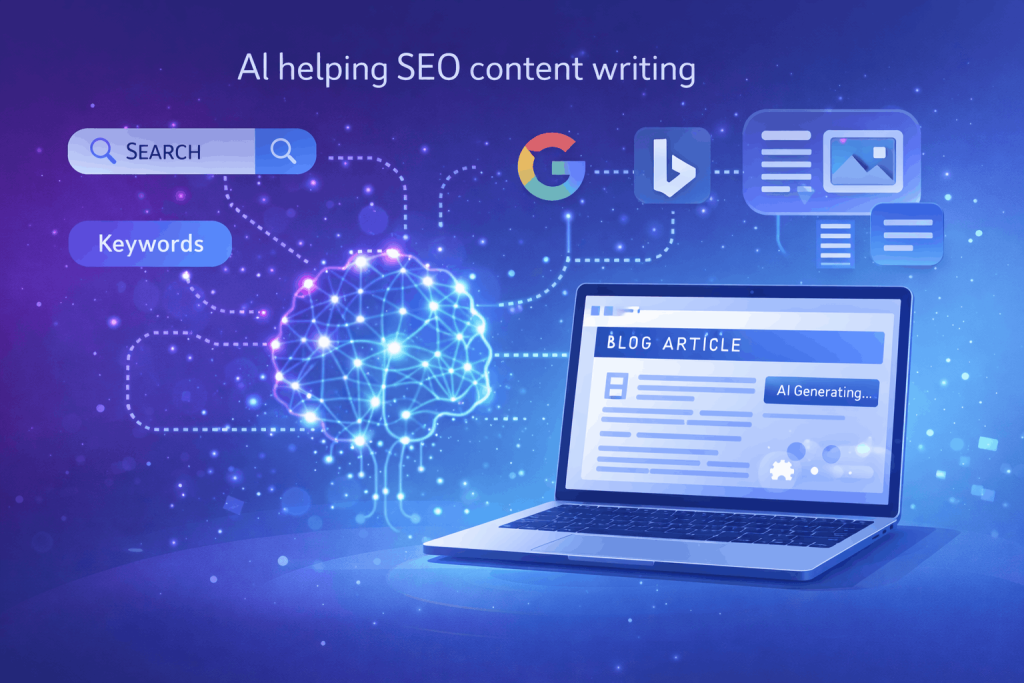
AI tools can help you write faster, generate ideas, and improve your SEO strategy. But here’s the truth: AI alone cannot rank your content on Google. You need the right approach.
In this blog, you will learn how to use AI for SEO content writing step by step, in a simple and practical way.
What is AI in SEO Content Writing?
AI (Artificial Intelligence) tools help you create content using machine learning and data.
Popular tools like ChatGPT, Jasper AI, and Copy.ai can:
- Generate blog ideas
- Write articles
- Suggest keywords
- Improve readability
But remember: AI is a helper, not a replacement for human thinking.
Why Use AI for SEO Content Writing?
Here are some simple benefits:
- Saves time
- Helps generate ideas quickly
- Improves writing structure
- Assists in keyword placement
- Helps create bulk content
Important: If you depend 100% on AI, your content may feel robotic. You need to add a human touch.
Step 1: Start with Keyword Research
Before writing any content, you need to find the right keywords.
You can use tools like:
- Google Keyword Planner
- Ubersuggest
- SEMrush
What to look for:
- High search volume
- Low competition
- User intent (what people are searching for)
Example keyword:
“How to Use AI for SEO Content Writing”
Step 2: Use AI to Generate Blog Ideas
Once you have a keyword, use AI to generate content ideas.
Example prompt:
- “Give me blog outline for ‘How to Use AI for SEO Content Writing’”
AI will give you headings, structure, and ideas.
Tip: Don’t copy everything blindly. Choose what fits your audience.
Step 3: Create a Proper Content Structure
Good SEO content is well-structured.
Use:
- H1 (main heading)
- H2 (subheadings)
- H3 (supporting points)
AI can help you build this structure quickly.
Example structure:
- Introduction
- What is AI in SEO
- Benefits
- Step-by-step guide
- Conclusion
Why it matters:
Google understands structured content better.
Step 4: Generate Content Using AI
Now comes the writing part.
You can ask AI:
- “Write a simple introduction for beginners”
- “Explain this topic in easy language”
But don’t do this:
❌ Copy and paste full AI content
Instead:
✔ Edit and rewrite
✔ Add your own examples
✔ Simplify the language
Goal: Make it feel human, not robotic.
Step 5: Optimize Content for SEO
SEO is not just about writing it’s about optimization.
Important SEO elements:
- Use your focus keyword in:
- Title
- First paragraph
- Headings
- Add internal links
- Use short paragraphs
- Add bullet points
AI tools can suggest optimization ideas, but you should review them.
Step 6: Improve Readability
Your content should be easy to read.
Use:
- Short sentences
- Simple words
- Clear structure
AI can rewrite complex sentences into simple ones.
Example:
Instead of:
“Utilizing artificial intelligence for content creation enhances productivity.”
Write:
“Using AI for content writing saves time and makes your work easier.”
Step 7: Add Human Touch
This is where most people fail.
AI cannot replace:
- Your experience
- Your understanding
- Your real examples
Add:
- Personal insights
- Real-life examples
- Simple explanations
Example:
Instead of just explaining SEO, you can say:
“When I started using AI for content writing, I noticed faster results but only after editing properly.”
This builds trust.
Step 8: Use AI for Meta Tags & Titles
AI can help you create:
- Meta titles
- Meta descriptions
- SEO-friendly headings
Example prompt:
- “Write an SEO meta description under 160 characters”
This saves time and improves optimization.
Step 9: Check for Errors & Quality
Before publishing:
- Check grammar
- Remove repetition
- Improve clarity
You can use tools like:
- Grammarly
Important: Always review content manually.
Step 10: Update Content Regularly
SEO is not a one-time process.
You should:
- Update old blogs
- Add new information
- Improve keywords
AI can help you refresh content quickly.
Common Mistakes to Avoid
Many beginners make these mistakes:
❌ Copying AI content without editing
❌ Ignoring user intent
❌ Overusing keywords (keyword stuffing)
❌ Writing only for Google, not for people
❌ Publishing low-quality content
Avoid these to get better results.
Best AI Tools for SEO Content Writing
Here are some useful tools:
- ChatGPT – Best for content writing
- Jasper AI – Good for marketing content
- Copy.ai – Good for short content
Choose based on your needs and budget.
Conclusion
Now you understand how to use AI for SEO content writing in a simple and practical way.
Start with:
- Keyword research
- Smart use of AI
- Human editing
- Proper SEO optimization
The future of content writing is not AI vs human —
It’s AI + human together.