
Artificial Intelligence is changing the way businesses work. From creating content and analysing data to running ads and answering customer questions, AI can now handle many marketing tasks in just a few minutes.
This brings an important question:
Will AI replace marketing jobs completely?
The short answer is no — but marketing jobs will change.
AI in Marketing is becoming an important part of modern business. It can save time, process huge amounts of data and automate repetitive work. But marketing is not only about data, tools and automation. It is also about understanding people, emotions, culture, trust, creativity and business goals.
That is where humans are still very important.
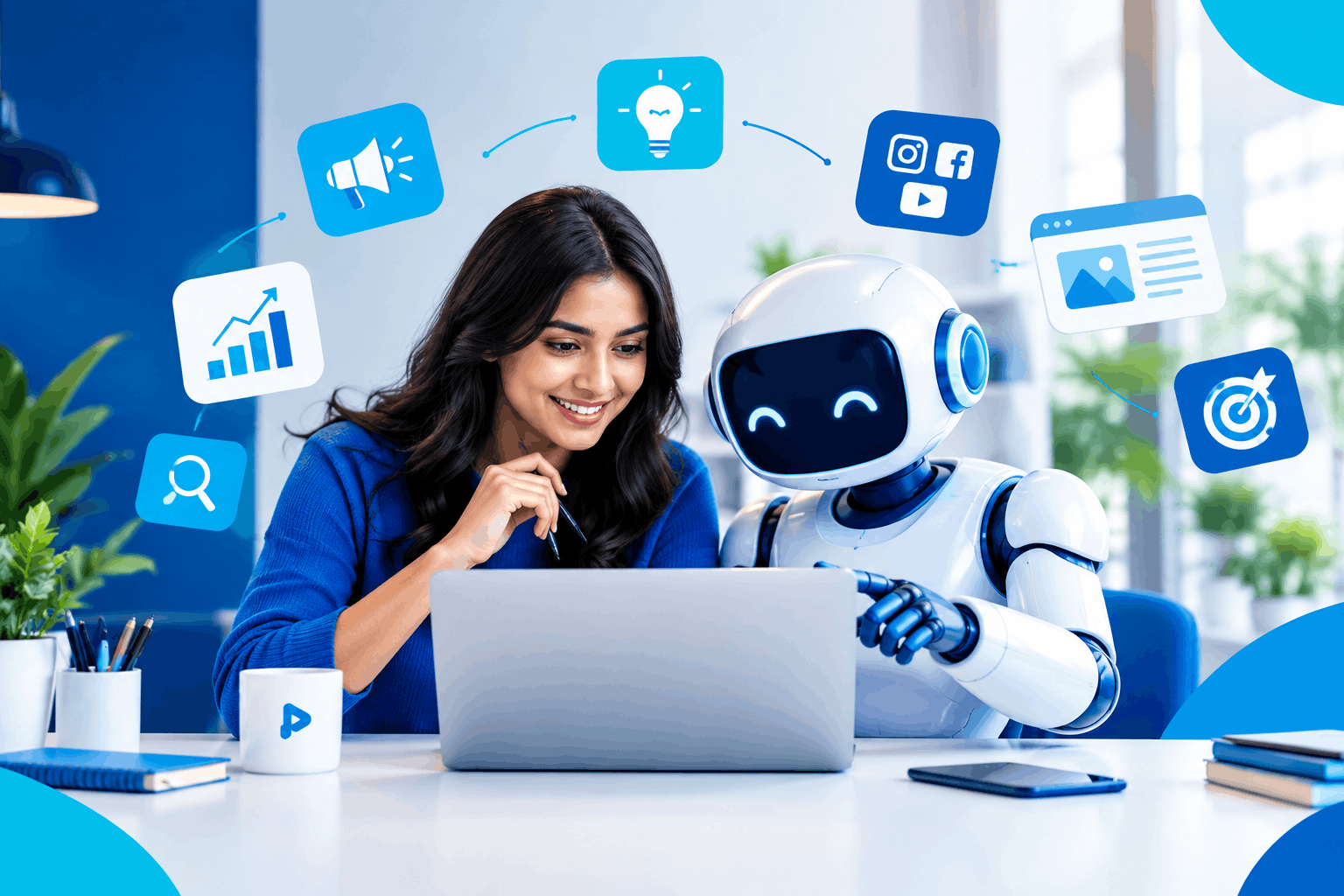
The future of marketing is not simply AI vs humans. The better approach is AI + humans working together.
If a business completely depends on AI, it can lose the human touch. If a business completely ignores AI, it may become slower, more expensive and less competitive.
So, the real question is not whether we should choose AI or humans.
The real question is:
How can businesses use AI and human skills together to build better marketing?
What Is AI in Marketing?
AI in Marketing means using artificial intelligence tools and systems to support different marketing activities.
AI can help businesses collect and understand data, create content ideas, analyse customer behaviour, automate communication, improve advertising campaigns and perform many repetitive tasks.
For example, AI can help a marketing team:
- Generate content ideas
- Create first drafts of social media posts
- Analyse customer data
- Find patterns in campaign performance
- Suggest keywords
- Help with SEO research
- Create advertising variations
- Automate customer replies
- Segment audiences
- Analyse competitors
- Predict possible customer behaviour
- Create reports
This does not mean AI can understand every customer or business situation perfectly.
AI works with information and patterns. Humans bring experience, judgement, emotions and real-world understanding.
Will AI Replace Marketing Jobs?
AI may replace some marketing tasks, but that is different from replacing the entire marketing profession.
Many repetitive tasks can already be automated. A marketer who spends hours creating reports, checking data or preparing basic content may now complete those tasks much faster with AI.
This means the role of a marketer is likely to change.
Instead of spending most of the day doing repetitive work, marketers can spend more time on:
- Strategy
- Creative thinking
- Brand building
- Customer relationships
- Campaign planning
- Business decisions
- Market research
- Storytelling
- Communication
So, AI may not remove marketing completely. Instead, it can change what marketers spend their time doing.
Where AI Is Better Than Humans
There are many areas where AI can work faster than a human.
1. Data Analysis
Marketing campaigns create a large amount of data.
AI can process this data quickly and identify patterns that may take humans much longer to find.
It can help analyse:
- Click-through rates
- Conversion rates
- Customer behaviour
- Website traffic
- Ad performance
- Search trends
- Audience activity
A human marketer can then use these findings to make better decisions.
2. Repetitive Marketing Tasks
Repetitive work can take a lot of time.
AI can help automate tasks such as:
- Basic reporting
- Data sorting
- Content drafts
- Email automation
- Customer segmentation
- Basic campaign monitoring
- Content scheduling
This allows marketing teams to focus on higher-value work.
3. Content Ideas
AI can generate many content ideas very quickly.
For example, a business can ask AI for:
- Blog topics
- Social media ideas
- Video concepts
- Ad copy ideas
- Email subject lines
- Content calendars
However, these ideas still need human review.
AI can provide the starting point. A human should decide which idea actually fits the brand.
4. Personalisation
AI can analyse customer behaviour and help businesses deliver more relevant messages.
For example, an online store can show different products to different customers based on their previous activity.
This can make marketing more relevant and useful.
5. Marketing Automation
AI can help businesses automate many parts of the customer journey.
For example:
Customer sees ad → visits website → fills form → receives email → gets follow-up message → sales team receives lead.
A well-designed system can reduce manual work and improve response time.
Where Humans Are Still Better
Even though AI is powerful, there are important areas where human involvement remains necessary.
1. Creativity
AI can generate images, text, ideas and concepts.
But creativity is not simply about producing something.
Good creative work needs a reason behind it.
A human designer or creative professional can ask:
Why should this design look like this?
What should the customer feel?
Does this visual match the brand?
Will this idea connect with the audience?
AI can support creativity, but human creative direction is still very important.
2. Understanding Emotions
Marketing is ultimately about people.
People do not always make decisions based on data.
They buy because they trust a company. They connect with a story. They feel an emotional connection with a brand.
Human marketers understand emotions, social behaviour and cultural differences in ways that automated systems may not fully understand.
3. Brand Strategy
Building a brand is more than creating logos and social media posts.
A strong brand needs:
- A clear identity
- Positioning
- Personality
- Brand message
- Customer understanding
- Long-term direction
AI can provide research and suggestions, but business owners and experienced marketers need to make the final strategic decisions.
4. Client and Customer Relationships
Customers often want to speak with a real person.
When a customer has a complex problem, a simple automated response may not be enough.
Human communication creates:
- Trust
- Understanding
- Relationship
- Confidence
- Long-term connection
This is especially important for B2B marketing, consulting, professional services and high-value products.
5. Decision Making
AI can recommend an action based on available data.
But business decisions often involve more than numbers.
A business owner may need to consider:
- Budget
- Risk
- Competition
- Brand reputation
- Customer relationships
- Business goals
- Market conditions
Humans need to make the final judgement.
What Happens If We Completely Depend on AI?
AI can be extremely useful, but depending on it for everything can create problems.
Loss of Brand Personality
If every business uses AI-generated content without human editing, many brands may start sounding similar.
The content may be technically correct but feel empty.
Less Original Thinking
If marketers accept every AI suggestion without thinking, creativity can become limited.
AI learns from existing patterns. Humans can challenge those patterns and create something different.
Wrong Decisions
AI can provide incorrect or unsuitable recommendations.
Bad data can also lead to bad results.
This is why human checking is important.
Less Customer Connection
Customers do not want to feel like they are always talking to a machine.
For many businesses, human connection is still a major part of building trust.
What Happens If We Completely Ignore AI?
The opposite approach also has problems.
A business that completely ignores AI may spend more time and money on tasks that could be automated.
For example, a marketing team might spend hours preparing reports that AI could help generate in minutes.
They may also struggle to analyse large amounts of data quickly.
Competitors using AI may move faster, test more ideas and respond to market changes sooner.
Ignoring AI does not protect marketing jobs.
Instead, it may make a business less competitive.
The Better Approach: AI + Humans
The strongest marketing model is not AI or humans.
It is:
AI for speed + Humans for intelligence, creativity and judgement.
Think of AI as a powerful assistant.
It can help you work faster, but it should not automatically become the final decision-maker.
For example:
AI: Finds keyword ideas
Human: Chooses the keywords that fit the business
AI: Creates a content draft
Human: Adds brand voice and real experience
AI: Analyses campaign data
Human: Decides what strategy to follow
AI: Generates design concepts
Human: Selects and improves the right creative direction
AI: Finds customer patterns
Human: Understands the reason behind customer behaviour
This combination can create much better results.
How AI + Humans Can Improve Marketing
Using both together can provide several major benefits.
Faster Work
AI can handle repetitive tasks quickly.
This gives marketers more time for important work.
Lower Operating Cost
When routine tasks are automated, businesses may reduce the amount of manual work required.
The saved time can be used for strategy, creativity and customer service.
Better Decisions
AI can process large amounts of data, while humans can add experience and business understanding.
Together, they can make stronger decisions.
More Testing
AI makes it easier to create and test different ideas.
For example, marketers can test multiple:
- Ad headlines
- Creative concepts
- Content ideas
- Landing page messages
- Audience segments
Humans can then review the results and improve the strategy.
Better Customer Experience
AI can provide fast support and personalised communication.
Humans can step in when the customer needs deeper support.
This creates a balance between speed and personal connection.
The Future Marketer Will Work Differently
The future marketer may not be someone who avoids AI.
Instead, successful marketers will learn how to work with AI effectively.
They will need skills such as:
- Marketing strategy
- Creative thinking
- AI tool usage
- Data understanding
- Communication
- Brand management
- Customer psychology
- Content planning
- Critical thinking
The value of a marketer will not only come from doing a task manually.
It will come from knowing:
What should be done?
Why should it be done?
Which AI tool should be used?
What should remain human?
How can the final result support the business goal?
These questions are much more important than simply knowing how to use an AI tool.
AI Will Replace Some Tasks — Not the Need for Good Marketers
This is probably the most realistic way to look at the future.
AI will continue to automate more marketing tasks.
Some traditional roles may become smaller or change significantly.
But businesses will still need people who can:
- Understand customers
- Build brands
- Create strategies
- Make decisions
- Develop creative ideas
- Manage relationships
- Understand business goals
- Take responsibility for results
In simple words:
AI can help create the work. Humans need to decide whether the work is worth using.
AI vs Humans: Which One Should Businesses Choose?
The answer is simple:
Do not choose only one.
Choosing only AI can make marketing fast but less personal.
Choosing only humans can make marketing personal but slower and harder to scale.
Using both creates a better balance.
| Marketing Area | AI | Human |
|---|---|---|
| Data analysis | Excellent | Strong |
| Repetitive tasks | Excellent | Low value |
| Content ideas | Excellent | Excellent |
| Brand strategy | Supportive | Essential |
| Emotional understanding | Limited | Strong |
| Creativity | Supportive | Essential |
| Customer relationships | Limited | Essential |
| Marketing automation | Excellent | Strategic control |
| Final decisions | Supportive | Essential |
| Business judgement | Limited | Essential |
The goal should not be to make humans compete against AI.
The goal should be to make humans more powerful with AI.
Final Thoughts
The future of marketing will not belong to companies that simply use the most AI tools.
It will belong to businesses that know where AI should be used and where humans should lead.
AI is excellent at speed, automation, data processing and repetitive work.
Humans are excellent at creativity, emotions, strategy, relationships and judgement.
When these two strengths come together, businesses can work faster without losing their human side.
So, will AI replace all marketing jobs?
Probably not. But marketers who know how to use AI may have a big advantage over those who refuse to learn it.
The future is not:
AI vs Humans.
The future is:
AI + Humans = Smarter Marketing.
Businesses should not completely leave AI.
Businesses should not completely leave humans either.
Use AI for what machines do best. Use humans for what humans do best. Then bring both together to build better marketing, better customer experiences and better business growth.